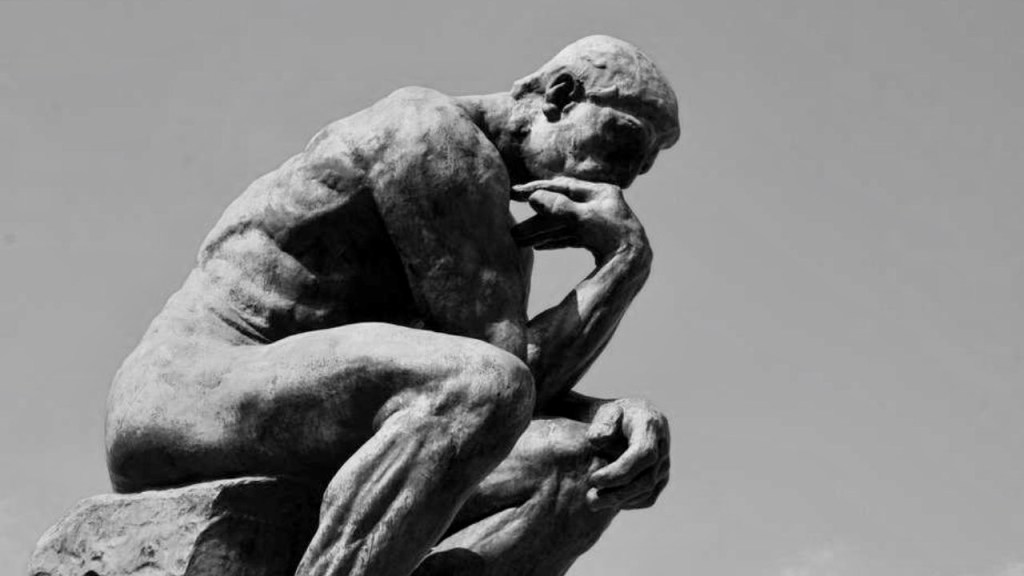
The Thinker
Influencing Reality
In Meditations, Marcus Aurelius appropriately observes: “All is as thinking makes it so”, alluding to the potential of thoughts to shape one’s reality. The Thinker must understand the power of this.
Beginning with an intuitive level of understanding; one has experienced the influence of thought on emotion and vice versa. For example, the thought of a particularly joyful experience will incite the emotion of joy in the person who thinks this. Alternatively, when the same person feels sad, their thoughts are also likely to reflect this.
Perhaps this example could be extended to mental health; with rates of depression and anxiety on the rise, one may attribute much of the suffering to the anguish experienced at the expense of negative thoughts.
Although this formula is not as simple as “Don’t Worry, Be Happy” as Bobby McFerrin may have suggested, it is undeniable that one’s thought’s shape one’s attitude to a large degree – the optimist’s perspective on reality is dramatically different to the pessimists.
To pull from Eastern philosophy: an individual’s thoughts are the cause of suffering and therefore, directly influence their perception and ultimately, experience of reality.
Thoughts may also be the result of environmental triggers – the external stimuli – which in turn influence how one perceives reality. In this sense, thinking becomes habitual as one encounters the same work colleagues, consumes the same media, eats the same food and consistently interacts with the same objects.
These environmental and external triggers reinforce the internal triggers – the thoughts – whereby one inevitably begins to overly identify with their thoughts. The Ego has a vested interest in these routines as it provides a comfort zone to flourish within and because of this, these thoughts are continuously recycled.
Joe Dispenza articulates this concept masterfully in his book Breaking the Habit of Being Yourself: How to Lose Your Mind and Create a New One.
“To change is to think greater than how we feel. To change is to act greater than the familiar feelings of the memorised self… So if we want to change some aspect of our reality, we have to think, feel, and act in new ways; we have to “be” different in terms of our responses to experiences.”
Put simply, Dispenza deduces that thinking, feeling and acting are all responses to “some aspect of our reality” – habits, routines or environmental triggers – and that creating new thoughts, involves shifting an external aspect of reality – the external influencing the internal or vice versa.
In light of this, one may conclude that thinking begins in response to outside events rather than inside. But is this so?
In Eastern philosophies, a conscious detachment from thought is encouraged as a means of achieving “stillness” or “mindfulness” alluded to in the previous part. That way, external triggers have little impact on one’s internal environment. A stoic calmness within neutralises the impact of external advertises.
Regardless of whether it is an awareness of the internal environment or a healthy detachment from the external, the Thinker, once they grasp this has access to live fully, shift their identity, and even influence far more than their own thoughts.
Such is the power of the Thinker to influence reality.
 CHANGE IS THE POINT